Renewable Consumption Obligation (RCO): What Replaced RPO, and What DISCOMs and Industrial Consumers Must Do Now
The Ministry of Power's 27 September 2025 amendment and BEE's Version 1.2 Operational Guidelines have turned RCO into a full statutory compliance framework — with defined exclusions, a CERC-determined buyout price, and audit-backed verification. Here's the current position, reconciled against the frameworks many teams are still planning around.
1. Critical regulatory update
- The 27 September 2025 MoP amendment superseded the 20 October 2023 RCO notification.
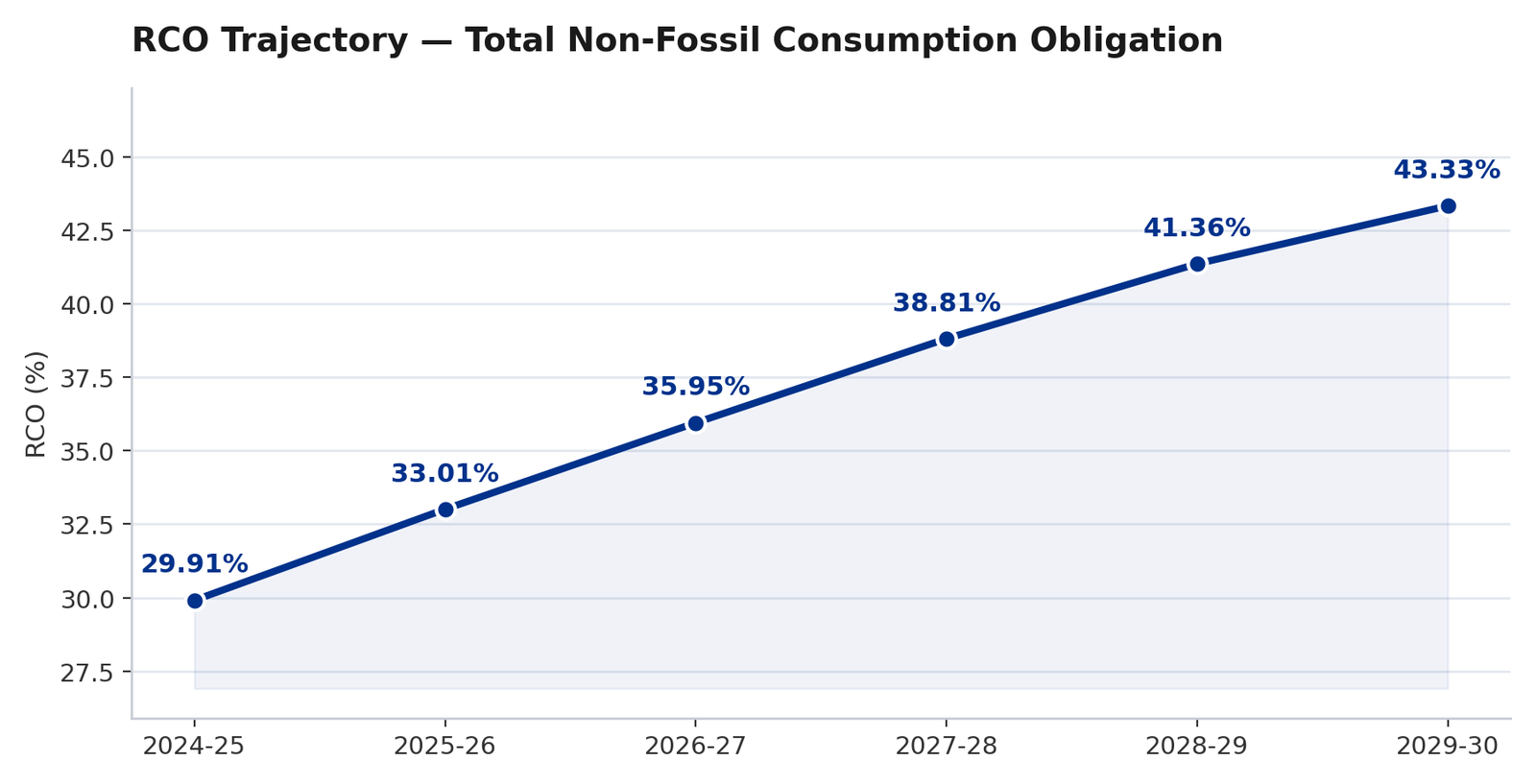
- The RCO trajectory itself is unchanged: 29.91% in FY 2024-25, rising to 43.33% in FY 2029-30.
- All distribution licensees are designated consumers (DCs) for RCO purposes; thermal power plants are not subject to RCO targets, since they generate primarily for sale.
- For industrial and commercial entities, DC status and the applicable notified sector/energy-consumption threshold must be established before assuming RCO applies at all.
- CERC determined RCO buyout prices in February 2026 and amended the REC Regulations in March 2026.
Executive takeaway: RCO is not merely an RPO rename. It is a statutory compliance framework under the Energy Conservation Act, with BEE-led monitoring, defined eligible sources and exclusions, audit and verification, multiple compliance routes, and a CERC-determined buyout mechanism.
2. RPO to RCO — why the change matters
RPO originated in electricity regulation. Section 86(1)(e) of the Electricity Act, 2003 requires State Electricity Regulatory Commissions (SERCs) to promote renewable electricity and specify a percentage of consumption for purchase from renewable sources. The REC mechanism created a tradable route for meeting these procurement obligations.
The Energy Conservation (Amendment) Act, 2022 inserted Section 14(x), empowering the Central Government — in consultation with BEE — to specify the minimum share of consumption of non-fossil sources by designated consumers. That created a statutory, consumption-based route under the Energy Conservation Act, distinct from the electricity-regulatory RPO route.
The 20 October 2023 notification operationalised the RCO framework from FY 2024-25. The 27 September 2025 amendment then refined it — including exclusions, fungibility, VPPA-linked RECs, and buyout.
3. Who is obligated?
3.1 Distribution licensees
BEE's current Operational Guidelines treat all electricity distribution companies/distribution licensees as designated consumers. Their RCO is measured with reference to electricity supplied to consumers in their area of supply, including distribution losses.
3.2 Industrial and commercial designated consumers
For non-DISCOM entities, RCO applies where the entity is a designated consumer in a notified energy-intensive sector and crosses the applicable annual energy-consumption threshold. The full 21-sector threshold table is in the downloadable toolkit below — aluminium, cement, iron & steel, fertiliser, textiles, and 17 other sectors each carry their own MTOE threshold.
4. RCO trajectory
4.1 DISCOMs
Figure 1 shows the total RCO trajectory that all distribution licensees must meet.
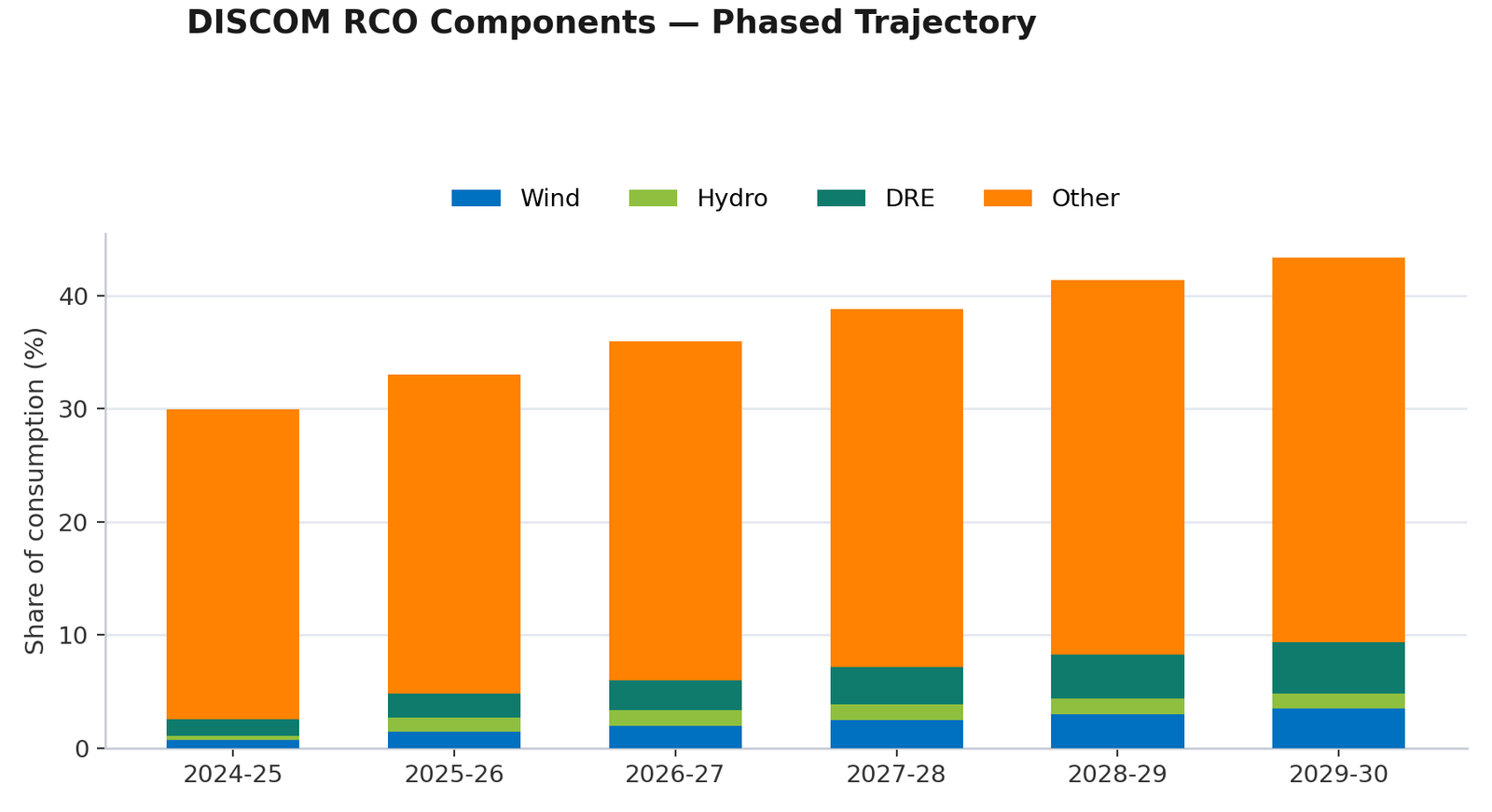
For DISCOMs specifically, the total is built from four technology components — Wind, Hydro, Distributed Renewable Energy (DRE) and Other — each with its own sub-trajectory (Figure 2).
4.2 Captive and open-access DCs
For captive and open-access designated consumers, the technology split doesn't apply — the current framework specifies a single total RCO rather than separate Wind/Hydro/DRE sub-targets.
5. Eligible sources, exclusions and fungibility
Eligible non-fossil sources
- Renewable sources such as solar PV, wind, hydro, biomass, biofuel, urban/municipal waste, geothermal and eligible hybrid projects.
- Nuclear is non-fossil in the broad sense, but electricity consumed from nuclear sources is expressly excluded from RCO.
- Energy generated/procured from eligible non-fossil sources and consumed through an energy storage system (ESS) can count — mere storage does not.
Important exclusions
- Nuclear electricity consumption is excluded.
- Qualifying waste-heat and waste-energy recovery self-consumption receives specified exclusion treatment.
- For captive users, 50% of electricity generated and self-consumed from fossil-fuel-based cogeneration is excluded.
- Non-DC operations of a DC are not automatically excluded — BEE states total electrical consumption is included in the denominator.
Fungibility
For DISCOMs, Wind, Hydro and Other components are fungible, and surplus DRE can offset shortfalls elsewhere — but a DRE shortfall is restrictive and must be met through DRE itself, relevant RECs/self-retention, or buyout. For OA/CPP DCs, the obligation is simply a single total RCO.
6. Compliance routes and buyout prices
CERC's 18 February 2026 order derived ₹347/MWh for FY 2024-25 and FY 2025-26 from the weighted average REC price, and applied a 5% annual escalation for later years, subject to review.
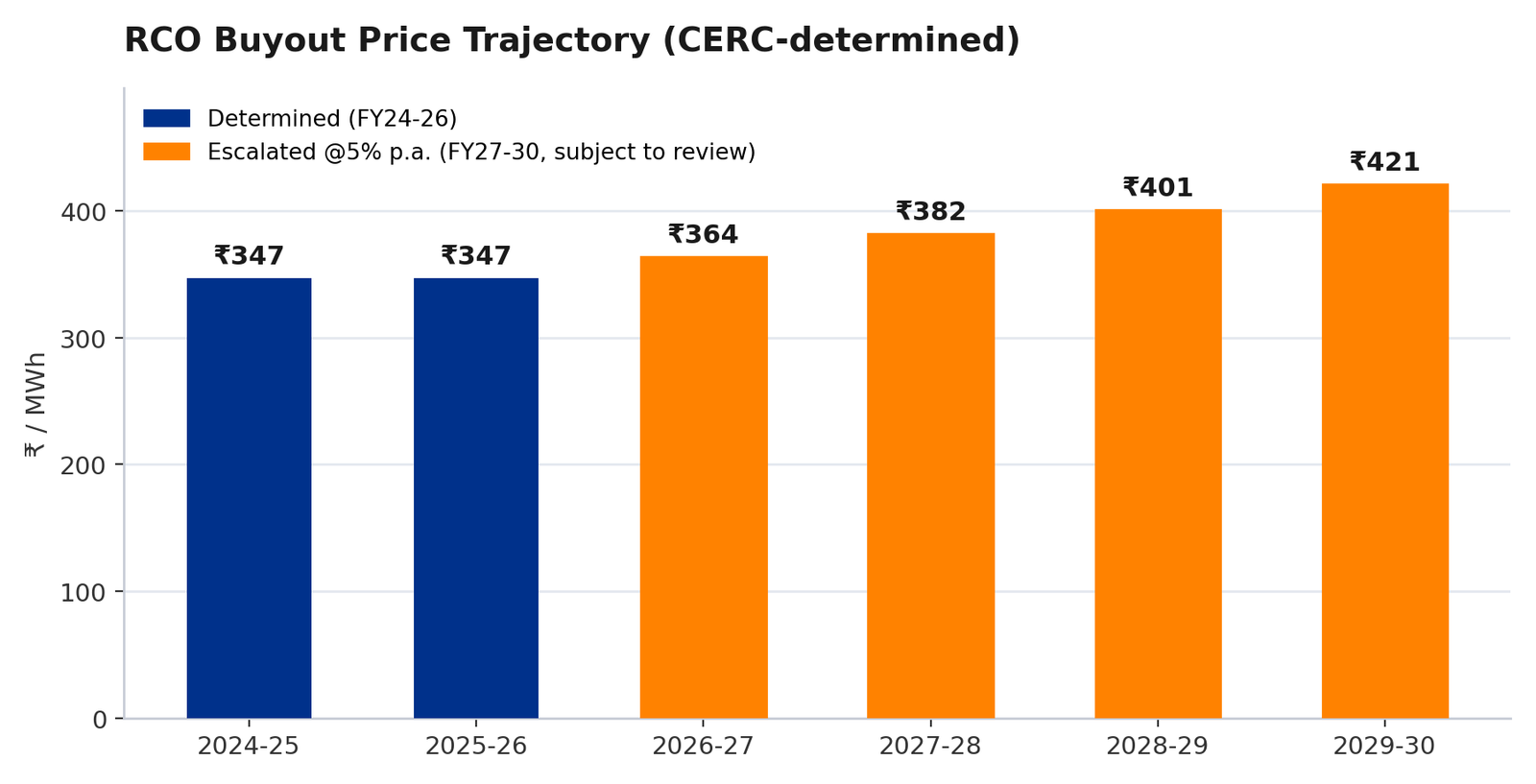
Buyout should be treated as a last-resort backstop, not a primary compliance strategy — direct renewable consumption, ESS-mediated consumption, and RECs (including VPPA-linked RECs, subject to the current CERC framework) all rank ahead of it.
7. RPO vs RCO — the comparison
| Dimension | RPO | RCO |
|---|---|---|
| Legal foundation | Electricity Act, 2003; Sec. 86(1)(e) | Energy Conservation Act; Sec. 14(x) |
| Regulatory purpose | Promote/procure renewable electricity | Drive measurable renewable/non-fossil consumption |
| Entity test | Obligated entity under RPO rules | Designated consumer + notified RCO applicability |
| Enforcement route | Electricity regulatory framework | Energy Conservation Act enforcement |
| Current covered-DC relationship | Subsumed within RCO per BEE guidelines | Current operative framework |
The full nine-row comparison — including DISCOM treatment, OA/CPP treatment and compliance-evidence differences — is in the downloadable toolkit.
8. Key risks, in brief
The most consequential failure modes we see: wrong DC classification, an incorrectly framed denominator, double-counting the same MWh through both direct consumption and certificates, and treating buyout as a primary rather than backstop strategy. The downloadable toolkit's Section 9 maps all nine risks to a specific control.
9. Practical FAQs
Is every large electricity consumer subject to RCO? No. DC status and the applicable sector/energy threshold must be established.
Does a captive plant automatically create RCO? No. The consumer must be an obligated DC; the detailed CPP methodology then applies.
Can RECs be used? Yes, subject to the CERC REC framework and BEE compliance procedure.
Can stored renewable energy count? Yes, when eligible energy is actually consumed after storage losses — mere storage does not count.
Is buyout allowed? Yes, under the current framework and CERC-determined price — it should normally be treated as a backstop.
Can group companies pool compliance? Yes, where BEE's corporate-level conditions are satisfied.
Does nuclear power count? No. Nuclear electricity consumption is expressly excluded.
Is 43.33% already applicable? No. That is the FY 2029-30 target; the applicable percentage depends on the target year.
Institutional architecture and reporting cycle, a full worked FY 2026-27 example, the complete 21-sector threshold table, procurement strategy, documentation & audit controls, corporate-level compliance, the full key-risks table, a 90-day implementation playbook, and management-dashboard + compliance-checklist appendices.
10. Source hierarchy and references
This article reconciles previously circulated RCO/RPO material with current official BEE, MoP and CERC sources available as at 27 August 2026. Where an older statement conflicts with a later official operational position, the later position is used.